Redding Eye Doctors Describe Corneal Endothelial Transplantation
Learn MoreMonovision
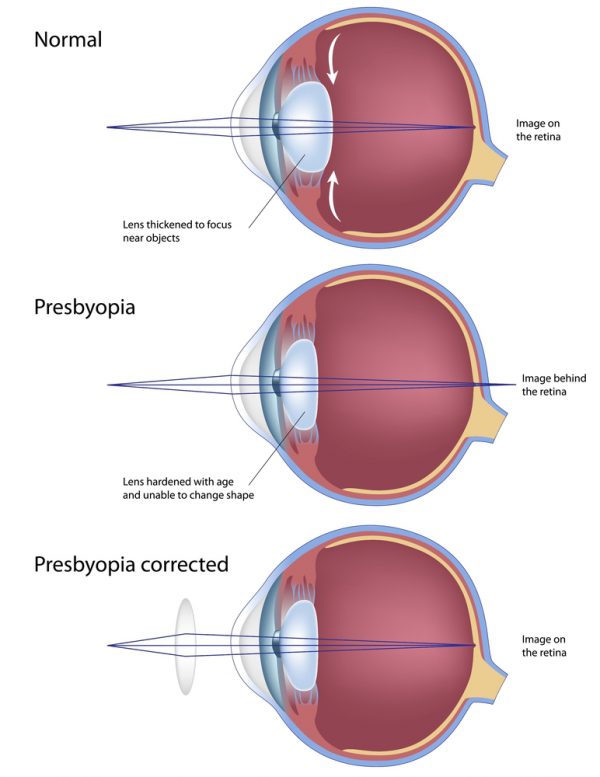
By the age of 40, many people begin to lose their ability to focus at different distances. Known as presbyopia, this deterioration in the ability to focus has traditionally been treated with reading glasses, bifocals, and contact lenses. At Riverside EyeCare Professionals, our board-certified ophthalmologists,—Dr. Michael Sumsion and Dr. Sean Sumsion—offer an advanced presbyopia treatment known as monovision. Utilizing this technique, an intraocular lens (IOL) designed to improve distance vision will be implanted into one eye while an IOL designed to improve near vision will be implanted into the other eye. Over time, the brain will typically adjust to the different lenses and learn which eye to use when focusing at short, far, and intermediate ranges.
What Are the Benefits of Monovision?
Monovision provides a versatile and effective way to address the visual challenges that come with presbyopia. By correcting one eye for distance and the other for near vision, the brain learns to naturally prioritize the appropriate eye depending on the task at hand. This approach significantly reduces, and in many cases eliminates, the need for reading glasses or bifocals in daily life. Patients often benefit from greater freedom during activities like reading, driving, and computer work.
Treatment options can range from contact lenses to laser surgery and intraocular lens implants, and because a contact lens trial can be performed first, patients can evaluate results before committing to a more permanent solution.
Who Is a Candidate for Monovision?
Monovision is generally a good fit for adults who have begun experiencing presbyopia and are looking for a way to maintain clear vision at multiple distances without the constant use of corrective eyewear. Ideal candidates are typically those with overall good eye health, realistic expectations, and a lifestyle that doesn’t place extreme demands on depth perception or binocular precision, such as high-level competitive athletics. A thorough evaluation by our ophthalmologists is an important first step, as factors like dominant eye preference, prescription strength, and daily visual habits all influence how well a patient is likely to adapt. In most cases, a contact lens trial is strongly recommended to simulate results across real-world activities before any permanent procedure is considered.
Most patients adjust to monovision in a relatively short amount of time; however, some people may have a hard time adjusting to two different lenses. Monovision may not be the most effective presbyopia solution for every patient and should be tested before any vision correction decisions are made.
Monovision vs. Other Presbyopia Treatments
Several treatment options exist for managing presbyopia, and understanding how monovision compares can help patients make a more informed decision. Reading glasses are the simplest and most accessible solution, but many patients find them inconvenient, requiring them to be carried at all times and swapped on and off throughout the day.
Bifocals and progressive lenses offer a more integrated approach within a single pair of glasses, though some people struggle with the visual transitions between zones. Multifocal contact lenses can address near, intermediate, and distance vision simultaneously using both eyes, which often feel more natural and preserve better depth perception, but may also introduce halos or reduced contrast, particularly in low-light settings.
Monovision, by contrast, uses a straightforward single-focus lens in each eye, which tends to produce sharper, more consistent clarity at each designated distance with fewer optical side effects. The best treatment ultimately depends on a patient’s prescription, lifestyle, and visual priorities.
Schedule a Consultation with Dr. Sumsion
To learn more about monovision, or to schedule a consultation with one of our ophthalmologists, please contact Riverside EyeCare Professionals today.