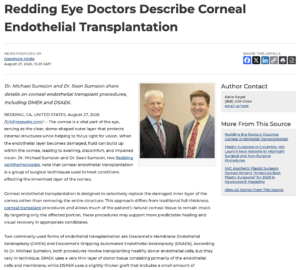
Redding Eye Doctors Describe Corneal Endothelial Transplantation
Learn MoreRefractive Lens Exchange
What is Refractive Lens Exchange?
Refractive Lens Exchange, or RLE, is a vision correction procedure that uses an intraocular lens (IOL) implant to to improve nearsightedness, farsightedness, and/or astigmatism. RLE can reduce dependence on corrective eyewear and often serves as an effective alternative to LASIK and other laser vision correction procedures. Plus, refractive lens exchange can be very beneficial in cataract surgery procedures, helping to improve distance and/or near-vision once the cataracts have been removed.
- Refractive Lens Exchange Benefits
- Refractive Lens Exchange Candidates
- Refractive Lens Exchange Procedure
- Refractive Lens Exchange Recovery
- Refractive Lens Exchange Results
- Refractive Lens Exchange Cost
- Additional Refractive Lens Exchange FAQs
What Are the Benefits of Refractive Lens Exchange?
Nearsightedness, farsightedness, astigmatism, and presbyopia are vision conditions often caused by the eye’s natural crystalline lens losing its ability to focus clearly on what we see. Refractive lens exchange can improve these conditions and diminish your reliance on glasses and contacts by replacing the natural lens with an artificial lens. This advanced intraocular lens (lens implant) procedure can often be very beneficial for patients with very thin corneas or corneal conditions that exclude them from candidacy for laser vision correction. RLE can also be used for early treatment of cataracts. In addition, patients who have lens implants can eliminate the risk of developing cataracts later in life.
Who Is a Candidate for Refractive Lens Exchange?
Good RLE candidates are typically over 40 and experiencing presbyopia (age-related difficulty focusing up close) or significant nearsightedness, farsightedness, or astigmatism. Ideal candidates should have stable vision, healthy eyes free of active eye disease, and no visually significant cataracts (once cataracts form, the procedure is classified as cataract surgery). RLE is often recommended for those who aren’t good candidates for LASIK, such as people with high hyperopia or thin corneas, and who are motivated to reduce dependence on glasses or contacts. A comprehensive eye exam evaluating refractive error, eye health, and lifestyle needs determines true candidacy.
What Can I Expect from the RLE Procedure?
This procedure typically takes 20 to 25 minutes, or less. One eye will be treated at a time, spaced over two appointments in a one-to-two week period. Before your procedure begins, numbing eye drops and a mild sedative can be administered to keep you relaxed and comfortable throughout. A tiny, self-sealing incision is made to remove the natural lens and replace it with your chosen IOL, with no stitches required. Our board-certified ophthalmologists—Dr. Michael Sumsion and Dr. Sean Sumsion—perform all RLE procedures at Riverside EyeCare Professionals.
How Is Refractive Lens Exchange Recovery?
Recovery from RLE procedures is typically minimal, and most patients are able to resume normal daily activities the day after treatment. In some cases, it may take a week for patients to resume driving and/or return to work. Antibiotic and anti-inflammatory eye drops are usually prescribed to facilitate the healing process, and should be administered according to the instructions. Scheduled follow-up visits allow our doctors to closely monitor your progress and provide swift treatment in the event of rare complications. As you recover, you may experience blurred vision, halos, glare, and/or mild irritation while your eye adjusts. If you are having both eyes treated with RLE, the second eye is commonly treated within a week or two after the first eye.
It is common for the treated eye to be covered with a protective patch or bandage immediately after the procedure is finished. This vision impediment and any lingering effects of pre-procedure sedation require that someone drive you home after the procedure.
As you recover, you may experience blurred vision, halos, glare, and/or mild irritation while your eye adjusts. If you are having both eyes treated with RLE, the second eye is commonly treated within a week or two after the first eye.
How Are Refractive Lens Exchange Results?
The results of RLE can vary with each patient and depend largely on the type of IOL they have implanted; however, most patients experience a significant improvement in their vision and a reduced need for glasses and contacts. It may take several weeks for the final result of refractive lens exchange to become apparent. The outcome of your RLE procedure should remain consistent long-term, as there is a very minimal risk of vision deterioration or regression over time.
How Much Does Refractive Lens Exchange Cost?
Since each refractive lens exchange procedure is unique, the price for RLE is determined on a case-by-case basis. Factors that impact the total cost can include:
- Whether one eye or both eyes are treated
- The type of IOL implanted
- Complexity of the procedure
- Other treatment performed along with RLE (i.e. cataract removal)
The best way to find out how much it will cost to correct your vision with RLE is to schedule a consultation with one of our ophthalmologists. During this appointment, he can evaluate whether you are a good candidate for the procedure, determine the type of IOL that suits your needs, and provide you with a full quote for the price of RLE. It is possible that your medical insurance could cover part or all of your RLE procedure, and our helpful staff can check your benefits to find out what your out-of-pocket costs may be. To make the cost of treatment more budget-friendly, we offer financing for vision correction procedures through CareCredit®. Approved applicants may be able to select from low- or no-interest loans and flexible payment plan options that make receiving the care you want more affordable.
Additional Refractive Lens Exchange Frequently Asked Questions
-
Will it be painful?
You will have topical anesthesia placed onto your eyes with eye drops, along with a mild sedative; there are no needles typically involved with this procedure. Most patients experience only a small pressure sensation during RLE surgery. The incision made is very small. Once the lens implant has been placed, there is usually no need for sutures because it will seal itself. -
At what age is RLE typically recommended?
RLE is generally recommended for patients over 40, when presbyopia starts to develop and the natural lens begins losing flexibility. Some surgeons prefer candidates over 45 or 50, particularly for presbyopia correction. It’s not usually recommended for younger patients, who are typically better suited to LASIK. -
Will I still need glasses after refractive lens exchange?
TMany patients significantly reduce or eliminate their dependence on glasses after RLE, especially for reading and everyday distance vision. However, RLE cannot guarantee complete independence from glasses for everyone. Some patients may still need them for certain tasks, like fine print or night driving, depending on the intraocular lens chosen and individual healing. Our team can discuss which lens options best match your visual goals during your consultation.
Schedule a Consultation with Riverside EyeCare Professionals
If you would like more information on our refractive lens exchange procedures, or want to schedule a consultation with one of our experienced ophthalmologists please contact Riverside EyeCare Professionals.